Blockchain ETFs vs. Crypto ETFs: Companies Are Not Coins
Learn how business exposure differs from token exposure, and what to inspect inside a blockchain-themed portfolio.
Published
Reviewed & updated
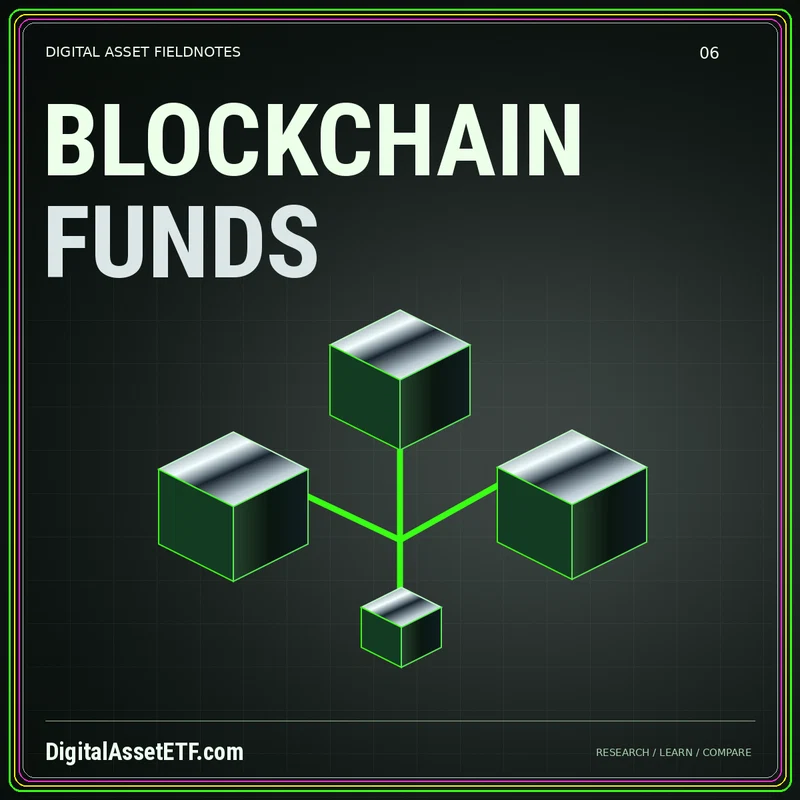
Blockchain investing is a theme, not a single portfolio. A fund can approach it through company shares, digital asset products, or a combination permitted by its documents. That range makes the category interesting to research, but it also creates room for a common misunderstanding: assuming a blockchain ETF is simply a diversified version of a bitcoin or ether holding.
Company shares and crypto assets represent different economic claims. A business has revenue, costs, financing choices, management decisions, and competitive pressures. A coin has its own network and market characteristics. Even when the two are related, their returns need not move together. A productive comparison starts by identifying which claim you are actually trying to understand.
Begin with the holdings, not the theme name
A blockchain equity fund typically focuses on companies connected to the development or use of blockchain technology. The exact eligibility rules and permitted investments come from its strategy documents. Do not assume every company earns most of its revenue from blockchain, or that the fund has no digital asset-linked holdings beyond equities.
BLOK provides a useful product-specific example. Amplify's current description says the fund invests at least 80% of net assets in equity securities of companies actively involved in blockchain development and use. Its materials also discuss exposure to bitcoin ETPs. That combination is a reason to inspect the full holdings, not to describe the fund as either a pure coin holding or an exclusively non-crypto portfolio.
Follow the business model
For an exchange operator, you might research transaction activity, pricing, operating expenses, and the mix of services. For a computing business, you might investigate capital needs, energy costs, customer demand, and equipment economics. A software provider introduces another set of questions about adoption, margins, and competition. The blockchain label does not replace those ordinary business fundamentals.
These examples are analytical categories rather than descriptions of current holdings in a specific fund. Their purpose is to show why one crypto-market headline can affect companies differently. A rise in a digital asset's price could help one business while higher input costs or dilution offset the benefit to its shareholders. The relationship needs investigation rather than a fixed assumed multiplier.
Revenue exposure is not the same as narrative exposure
A company can be associated with blockchain in presentations while generating most of its earnings elsewhere. Conversely, a less recognizable business may have material exposure through infrastructure or services. Determine how the fund identifies eligible companies and whether it distinguishes direct involvement from a smaller or emerging activity.
One practical exercise is to place each major holding into a business-model category, then note the evidence for its connection to the theme. That is more informative than counting how often blockchain appears in a company description. The learning center emphasizes this habit: translate a marketing category into a statement about the actual assets and economics.
Active and index approaches answer different questions
An actively managed strategy gives a manager discretion within the fund's mandate. An index-based strategy follows a defined methodology and its rebalancing rules. Neither label is a verdict on future performance. Each tells you where to focus the research: manager process and changes in one case, index construction and implementation in the other.
For an active strategy, ask what would cause the manager to add or remove an investment and how concentration is controlled. For an index strategy, examine eligibility, weighting, reconstitution, and treatment of companies with only partial theme exposure. An index can be rules-based without being economically neutral; the design of the rules still determines what the investor owns.
A larger number of holdings does not settle diversification
Imagine a hypothetical portfolio with twenty businesses that all depend heavily on the same source of customer activity. The number twenty describes its holdings count, not twenty independent economic drivers. If a common shock reduces activity across the group, several positions may decline together. The label diversified should therefore be tested against the actual exposures.
Our risk information page discusses concentration at both the fund and portfolio level. A blockchain fund may also overlap with technology funds or individual stocks already owned elsewhere. Comparing the combined exposures can reveal a concentration that was not obvious when each account or fund was viewed separately. More tickers are not automatically more distinct sources of risk.
Balance-sheet choices affect shareholders
A company's use of debt, share issuance, acquisitions, or asset holdings can change the investment outcome. A business associated with a rising digital asset can still deliver disappointing shareholder returns if financing costs or dilution outweigh the benefit. These are corporate-finance questions, not defects in an ETF's tracking mechanism.
Use an illustrative example: a company's total equity value rises 20%, while its share count rises 25%. Dividing 1.20 by 1.25 gives 0.96, implying a 4% decline in value per share under the simplified assumptions. The example is not about a named company. It demonstrates why business growth, theme growth, and per-share investor results should be kept separate.
Compare the objective with the intended role
Someone researching direct bitcoin price exposure and someone researching businesses building blockchain infrastructure are asking different questions. A blockchain equity fund may be relevant to the second inquiry while being an imperfect substitute for the first. Begin with the investment role rather than looking for the category with the best recent chart.
The Bitcoin ETFs hub and Ethereum ETFs hub cover coin-linked vehicles separately. The blockchain funds page focuses on corporate exposure. Keeping those paths distinct makes it easier to identify a mismatch before fee comparisons and historical returns distract from the original objective.
Read performance with an appropriate benchmark
A blockchain equity portfolio may be compared with a broad equity index, a thematic index, or another benchmark identified in its documents. A coin price can be an interesting reference, but it does not necessarily describe the fund's investment objective. Decide what question each comparison is intended to answer before interpreting outperformance or underperformance.
Use matched periods and consistent treatment of distributions. Also consider whether the fund's holdings or strategy changed during the period. A performance history can be real while describing a portfolio that is no longer identical to today's holdings. A current investment assessment needs both the historical record and the present mandate, with neither substituted for the other.
Costs still matter, but only after exposure is understood
A thematic equity fund's expense ratio is one part of the research. Trading costs, turnover, foreign-market exposure, and taxes may also matter depending on the product and investor. Avoid declaring a spot trust cheaper or more expensive in a meaningful sense without acknowledging that it may provide a different investment service.
The fee guide offers a way to separate recurring costs from execution and strategy effects. Once the exposures are understood, that structure helps compare similar alternatives fairly. Before that point, an attractive annual rate can conceal the more basic problem that the portfolio does not do what you expected.
The takeaway
A blockchain ETF is a portfolio to inspect, not a shortcut to owning a technology's future. Identify the companies and any other permitted instruments, trace their business economics, check concentration, and compare the strategy with its intended role. Read the Amplify BLOK product page for the specific issuer example discussed here. Use the ETF directory to keep that example in context rather than treating one fund as the definition of the entire category.
EXPLORE THIS TOPIC
Read the primary-source library for supporting context and the limits of the product snapshot. General education, not personalized investment advice.
← All ETF Insights